Why I Built an AI Farm Advisor After 20 Years in the Midwest Ag Industry
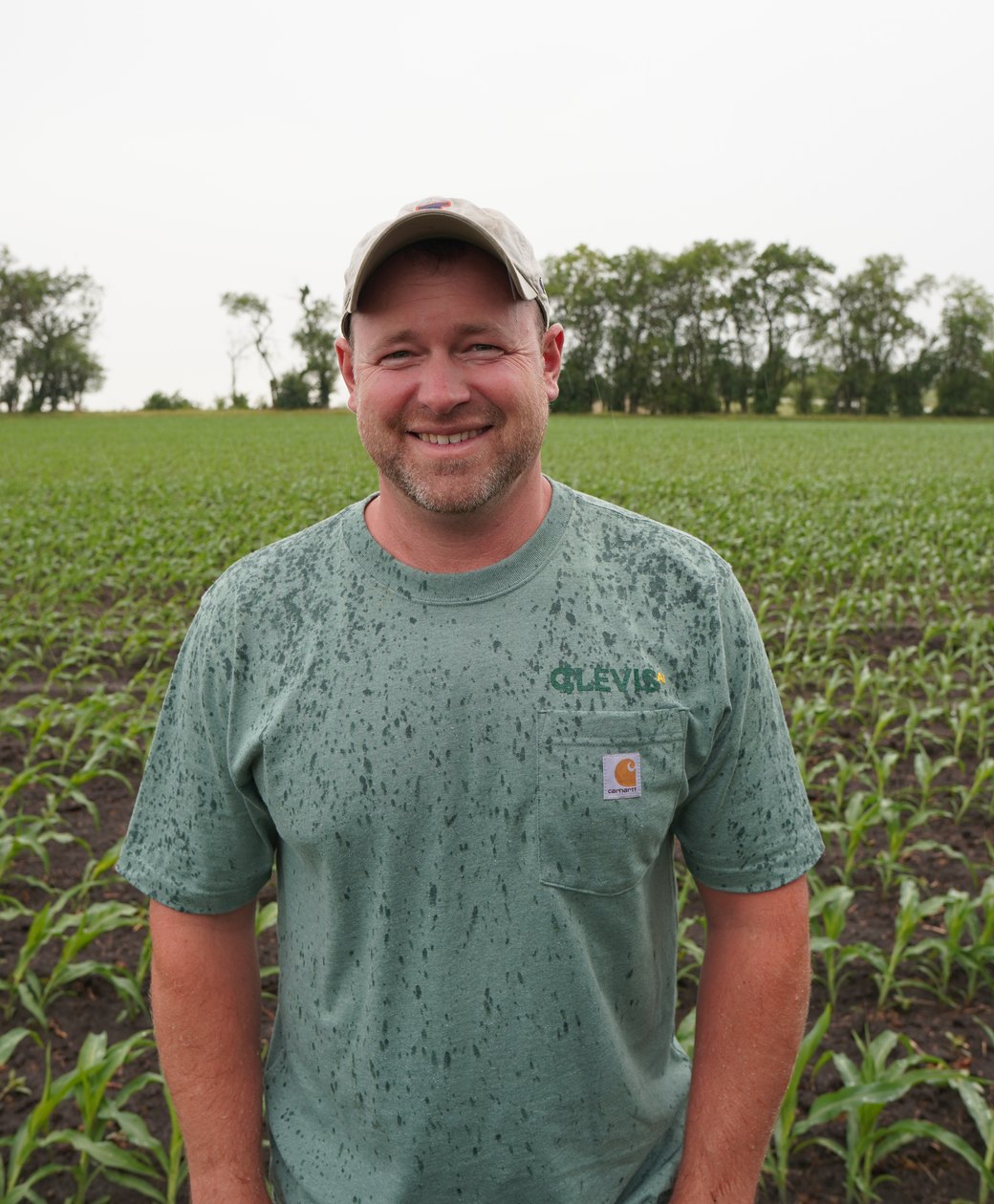
I'm a Midwest crop scientist turned independent consultant who spent 20+ years inside the ag industry before founding Clevis AI. Here's the day in central Illinois that made me certain farmers needed an AI advisor built farmer-up, not corporate-down.

The day two farmers told me what was wrong
One morning last spring, I sat across the desk from a farmer who runs one of the larger operations in central Illinois. His office had three other people in it. A full-time accountant who also handled his grain marketing. A secretary keeping the paperwork moving. An agronomist-manager who walked his fields almost every day during the season and knew the soil type of every quarter section by memory. The farmer himself was free to think — about expansion, about leases coming up for renewal, about whether he wanted to bid on a piece of ground over by the highway.
That afternoon I stopped at another farm. The grower there farmed about 2,500 acres — a normal-sized operation by any standard, the size most Midwest row-crop families farm. He met me at the door of his shop holding a stack of insurance paperwork he hadn't been able to get to. We talked for forty minutes, and somewhere in the middle of it he told me, almost in passing, that he hadn't yet been able to walk a field to scout for early-season pests. Planting had pushed it. Then a rain event. Then the loan renewal. He also told me he hadn't sold a bushel of new-crop corn yet. He knew he should. He knew the basis was wide. He just hadn't had the time to sit down and run the math.
The difference between those two farms isn't talent or work ethic. It isn't acreage, really — both men know their ground. The difference is that the first farmer has, for all practical purposes, a small executive team. The second farmer is the executive team. And the gap between them — the gap between I have someone whose only job is to think about my marketing decisions all day and I'll get to marketing this weekend if the weather lets me — is, on a thin-margin year, the difference between profit and loss.
I drove home that evening on Highway 47 thinking about something I'd been turning over for years: the skill set that the large farmer was paying three salaries for could now, at a fraction of the price, be built into software for the rest of the Midwest. Not as a replacement for any of those people. As a way for every other farmer in this state to have access to the same caliber of decision support that the top one percent of operations already have. That's the thought that became Clevis AI.
Why 2025 — and not 2015 or 2030
I want to be honest about the technical inflection point, because if you've followed AI for any length of time, you've watched a lot of overpromised software show up in farm offices and not survive the first dusty harvest season.
The reason this couldn't have been built five years ago is the same reason it would be foolish to wait five more. Large language models only became genuinely useful for grounded, operation-specific reasoning in the last 18 months. Before that, an "AI farm advisor" would either have to be a brittle rules engine that couldn't handle the messiness of a real farm, or a chatbot that hallucinated confidently when asked anything specific. Neither of those is what farmers need.
The shift that mattered was the moment AI could be reliably grounded in your own farm's data — your field boundaries, your soil maps, your stored bushels, your contracts, your local basis, your past planting decisions — and produce advice that was actually about your operation, not about an abstract "average Midwest farm." That's the capability that came online in 2025. And the moment it did, the whole opportunity I'd been sketching out in my truck for years became buildable.
Every AI farm tool you've used to this point — and I've used most of them — has one of two problems. Either it's a generic AI with no context (which means it's only as smart as the question you remember to ask it), or it's a single-purpose tool that knows one slice of your operation (marketing, or agronomy, or accounting) and has no idea what's happening on the other side of the barn. The opportunity that opened up in 2025 was the ability to do both: AI that knows your whole operation, integrates the slices, and reasons across them.
That's what makes the advice useful. A grain marketing tool can tell you that corn is up four cents. An AI that knows your operation can tell you that corn is up four cents, you have 38,000 bushels still in your bins, your operating note rolls in November, and based on your contracts you have room to lock in another truckload at the elevator twelve miles south. One of those is information. The other is a decision.
How I got here
I grew up near the family farm in Hancock County, in west-central Illinois, where my first jobs were the ones every farm kid recognizes — detasseling corn in July, baling hay in August. I went to the University of Illinois for crop sciences, finished undergrad in 2012, and stayed for a master's in 2014. My graduate work was on western corn rootworm resistance to Bt — what we used to call the billion-dollar bug, for the damage it does when it gets out from under our trait stacks.
After grad school I worked in the seed industry for several years on corn and soybean trait and germplasm development. The seed industry, for what it's worth, is fine. The people are sharp, the science is good, and the products move the yield needle in ways farmers benefit from. I'm not writing this to bash anyone I worked with — most of them are still great friends.
But about five years ago I left to start consulting independently. The reason was simple: every conversation I had inside the industry was, at its bones, a conversation about a future sale. Even the conversations that weren't about a specific product were happening in a context where the next product release was always six months out. I wanted to have conversations with farmers where the only thing I was selling was my time and my honest advice. I wanted my whole job to be them.
Five years of consulting in central Illinois will teach you what farmers actually need. It taught me that the thing farmers value most — more than the agronomy expertise, more than the marketing tips — is being able to trust that the person on the other end of the phone has their best interest in mind. That's not a relationship built on a future sale. It's a relationship built on I will tell you what I would do if it were my farm.
That trust is rare. It's also, I'd argue, the entire model rural America still gets right that the rest of the country has lost. Faith, family, neighbors who'll band together to help you get the harvest in after a sickness. The farming community is one of the best places left in America, and I wanted to spend the second half of my career inside it, not adjacent to it.
What consulting let me see
Inside the seed industry, you see your customer through the lens of one product category. Outside it, walking every farm and not selling anything, you see the whole operation.
The pattern I saw, over and over, was this: a 2,500-acre operation needs the same eight or nine decisions made well every year that a 15,000-acre operation does. Hybrid selection. Seed populations. Nitrogen timing. Pest pressure assessment. Storage versus sell-at-harvest. Forward contracts. Basis management. Cash flow planning. Equipment replacement timing. The big-operation farmer has a team to think through each of those. The mid-size farmer makes every one of them himself, in the truck between fields, between phone calls.
That's the gap an AI farm advisor can close. Not by replacing any of the people the big operation hires, but by giving the rest of the Midwest a comparable second brain to run decisions past.
I'll give you three specific examples from clients on Clevis right now, because they're more useful than abstractions.
One central-Illinois grower is saving about ten hours of paperwork per week, mostly during this past planting season. That's a full workday a week he gets back to walk fields, scout, or just be home for dinner or attend his kid's baseball game.
Another client got a pricing trigger from Clevis as corn prices started sliding off a recent high. The trigger fired because Clevis knew his operating budget, knew how many bushels he had in storage, and knew the basis at the elevators within his trucking radius. He locked in a contract that morning. Without the prompt he'd have noticed the move a day later — which, on that swing, was a meaningful chunk of margin per acre.
A third client used Clevis to identify black cutworm damage from a photo he uploaded from the field, log the affected acreage, and get a recommendation to apply an insecticide early enough to save a portion of the field that would otherwise have been a replant decision two weeks later.
None of those are flashy. They're the kind of small, well-timed decisions that compound across a season into the difference between a good year and a bad one.
What "independent" actually means
This part matters. "Independent" gets used loosely in ag-tech, so I want to say what it means at Clevis specifically.
We don't take seed-company money. We don't take equipment-dealer kickbacks. We don't resell your data to anyone — not to input suppliers, not to commodity traders, not to "ag analytics" platforms. The financial structure of the company is set up so that every dollar we earn comes from a farmer paying us directly to be useful to him. That structure is the entire reason the advice you get from Clevis can be trusted: there is no other party in the room.
I think a lot about a line from Nietzsche: "And if you gaze long into an abyss, the abyss also gazes into you." It's an old quote, but it applies cleanly to what's happening with AI and farm data right now. The AI companies that are pushing into agriculture — the big ones — are not in the business of farming. They're in the business of training models on your data and selling derivative products downstream. If something is free, you are the product. That isn't a slogan. It's how the model works.
I don't want farmers to look up in ten years and realize the AI tool they trusted with their planting maps and their cash-flow projections has quietly turned them into a commodity. I don't want a farmer's operating margin, his land transactions, his marketing decisions to be a data source for someone else's quarterly earnings call. We built Clevis so that farm data goes one direction: into your decisions, and nowhere else. Full data sovereignty isn't a feature on our pricing page. It's a structural commitment.
Why we built it in the Midwest
There's one more thing worth saying out loud, because I've watched it matter in every meeting I've taken with farm-tech companies based elsewhere: Clevis is built in the Midwest because Midwest farmers deserve software designed by people who can find their farm on a map without a GPS.
My CTO Caleb grew up on his family's farm near Quincy, about an hour from where I grew up. He still goes home during planting and harvest. We are not running a Bay Area startup with a marketing department that does focus groups with farmers twice a year. Our team is made up entirely of folks who grew up on Midwest family farms building software for Illinois, Iowa, Indiana, and the rest of the row-crop Midwest, with the rhythm of the season baked into how we work.
That choice shows up in the product in ways you can feel. When the markets close at 1:15 Central, our morning brief is already in your inbox. When you ask Clevis a question about a field, it knows that field's soil types, its yield history, its hybrid for the year, and what was planted last year. When harvest hits and you're running fourteen hours a day, the app doesn't ask you to type — you scan a scale ticket with your phone camera and Clevis logs the delivery to the right contract automatically.
The analogy I keep coming back to is the old John Deere 4020. That tractor was built to last fifty years, and a lot of them have. Farmers don't need software designed for the venture-capital cycle. They need software designed the way a 4020 was designed: solid, useful, trustworthy, and still working the day your grandkids drive it.
That's what we're trying to build.
What Clevis is, exactly
To pull it together: Clevis is an independent AI farm advisor for Midwest corn, soybean, and wheat growers. It knows your fields, your bins, your contracts, your local basis, your past decisions. It gives you a daily morning brief with the markets and the field needs. It logs your expenses from receipt photos. It scans scale tickets at harvest. It tracks your forward contracts and alerts you when your storage plus basis math says it's time to move a load. It identifies pest and disease pressure from a photo. It runs sub-acre inference on your operation — both proactive (here's what to look at today) and reactive (here's what to do about what you just saw) — and it does all of it grounded in your specific farm, not an industry average.
It is not a replacement for your agronomist, your banker, your marketer, or your neighbor. It is a second brain that runs every decision through the full context of your operation so that the people you do trust — including yourself — can think clearly.
The second farmer I visited last spring is on Clevis now. He hasn't hired anyone. He's just stopped losing decisions to the calendar.
If you farm corn or soybeans in the Midwest, I'd be honored to have you try it. And whether or not you ever pay us a dollar, you're welcome on the morning brief — that's free, that's farmer-up, and that's how we'd like to start the relationship.
Keep reading
- Skeptics · 8 min read
AI for Grain Farmers: An Honest Field Report
I've watched software get sold to farmers for twenty years, so here's the straight scorecard on AI for grain farmers — where it earns its keep, where it still falls short, and what changes in the next month or two.
Read - Marketing · 5 min read
Farm Marketing AI: How an AI Advisor Changes the Grain-Marketing Workflow
Grain marketing is where a year's profit is made or lost — and the task farmers most often run out of time for. Here's how an AI farm advisor rebuilds the marketing workflow around your operation, step by step.
Read - Agronomy · 5 min read
Will AI Replace Your Crop Consultant? An Honest Take
Short answer: no — and here's the part most people miss. Your agronomist is probably already using AI. So the real question isn't human vs. machine; it's what an AI grounded in your whole operation adds to the expertise you already trust.
Read - Accounting · 7 min read
Farm Accounting vs. QuickBooks: Why Your Books Should Know Your Fields
QuickBooks can tell you the farm made money. It can't tell you which fields made it. Here's the honest case for farm-native accounting — books that are organized by field, crop, and bushel instead of by generic ledger account — and how you can keep QuickBooks for what it's good at while you make the switch.
Read - Agronomy · 8 min read
In-Season Corn Decisions: The Calls That Make or Break the Crop
Corn makes its yield in a handful of narrow windows between emergence and grain fill — and most of those decisions get made in the truck, between everything else. Here's the in-season decision sequence that actually moves yield, and how an AI advisor grounded in your fields helps you catch each window on time.
Read