Will AI Replace Your Crop Consultant? An Honest Take
Short answer: no — and here's the part most people miss. Your agronomist is probably already using AI. So the real question isn't human vs. machine; it's what an AI grounded in your whole operation adds to the expertise you already trust.

The question everybody's actually asking
When I talk to farmers about AI and agronomy, the question under the question is almost always the same: is this going to replace my agronomist?
Let me answer it straight, and then tell you why it's the wrong question.
No. AI is not going to replace a good crop consultant. But here's the part most of that conversation misses: your agronomist is very likely already using AI. The tools that identify a disease from a phone photo, flag a deficiency, or generate a fertility recommendation are already in the hands of a lot of the consultants walking your fields. This isn't humans on one side and machines on the other. The good agronomists are adopting these tools the same way they adopted yield monitors and grid sampling — as another way to be better at the job.
So the real question isn't "AI or my agronomist?" It's: given that AI is now part of agronomy whether you think about it or not, what kind of AI do you want working on your operation, and grounded in what?
What a crop consultant actually gives you
I spent five years consulting independently, so I'm not going to undersell this. A good agronomist gives you things software does not.
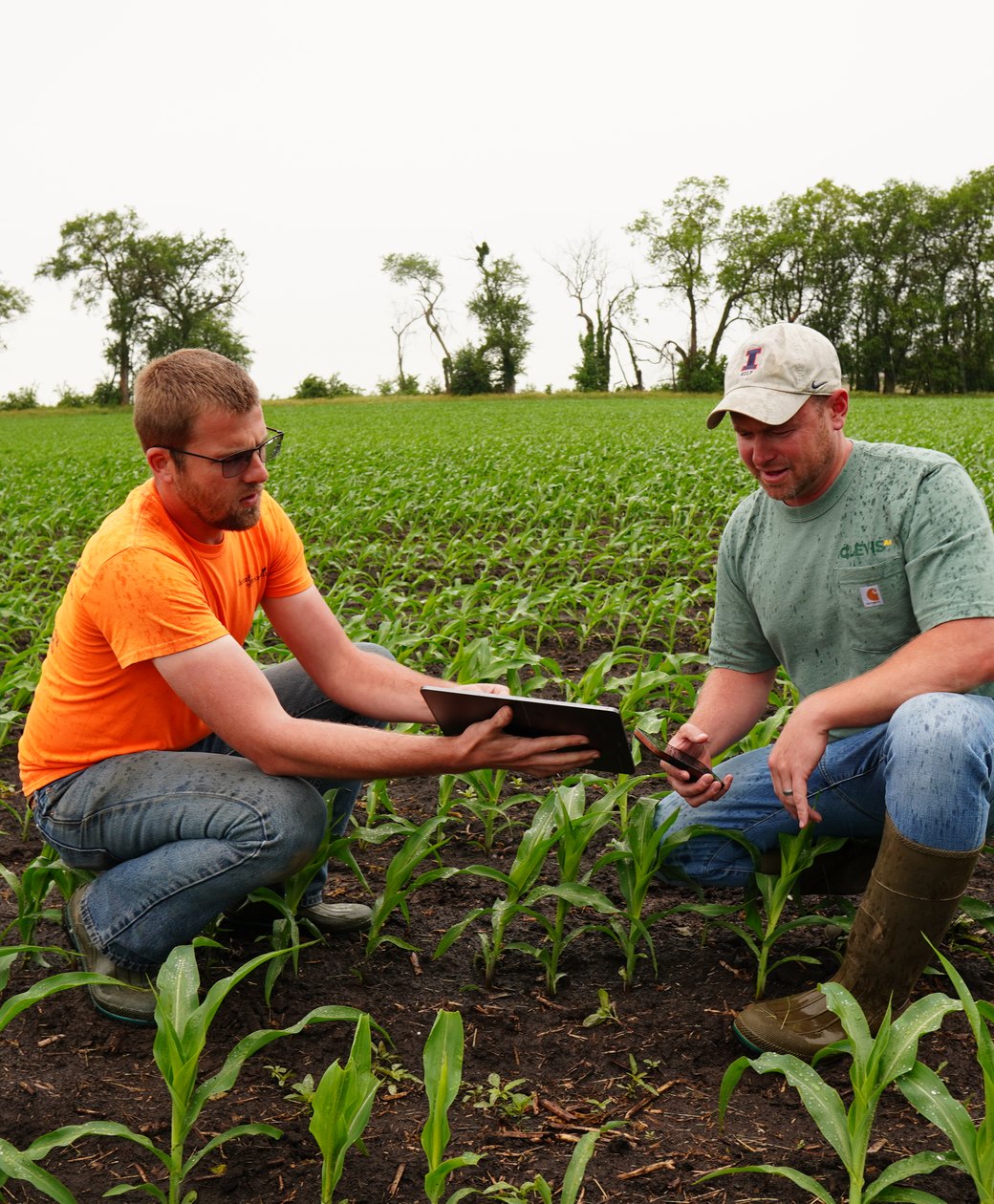
They walk your fields. They put boots in the dirt and see the things a photo misses — the pattern across the whole field, the soil in their hand, the thing that doesn't look right even though they can't name it yet. They bring years of judgment about your specific ground. And maybe most important, they bring a relationship and accountability: someone who will look you in the eye and tell you what they'd do if it were their farm, and who's on the hook for that advice.
None of that goes away because the consultant also runs a photo through an AI tool. If anything, the AI frees them to spend their judgment where it matters. A consultant with good AI tools is more valuable than one without — not less.
What an AI farm advisor adds on top
So if your agronomist is already using AI, what does an AI farm advisor like Clevis add? Not "smarter agronomy" in a vacuum. Three specific things:
It's always on — and it reaches out first. Your consultant sees your fields on a schedule — every week or two in season if you're lucky, and that's a good consultant. An AI advisor is there every day. And because it's continuously tracking field-level data — accumulated growing degree days, cumulative rainfall on each field, and satellite NDVI refreshed roughly every three days — it can infer how your crop is likely responding and flag something before you go looking. That's the part that's genuinely new. Most tools, and most field visits, are reactive: you bring a question, you get an answer. This is proactive, field by field — our algorithmic inference surfacing what's worth looking at today, before it turns into a problem. The honest version of the founder's promise I keep coming back to: sub-acre inference, both proactive and reactive.
It's grounded in your whole operation, not just the leaf in the photo. A standalone diagnostic tool — the kind a consultant might use — knows the disease in the picture. That's useful, but it's a fragment. Clevis knows the disease and that it's your field, your hybrid this year, your yield history on that ground, your budget, and what it would cost to treat versus the acres at stake. The diagnosis is the easy part. The decision — is it worth spraying, on this field, this year — needs the rest of your operation, and that's what the AI holds together.
It keeps profitability at the center. This is the one that changes the answers. Most agronomic advice, human or AI, is quietly optimizing for the healthiest, highest-yielding crop. That's the agronomist's job, and it's the right instinct most of the time. But the most-bushels answer and the most-profit answer aren't always the same. Our management zones run on profitability per acre — so the back corner you've fed inputs into for years because it bothered you to see it yield light may get a different recommendation than "push it harder." Margins are thin enough that the gap between those two questions is real money. (I went into this more in the honest field report.)
What Clevis does on agronomy today
To be concrete about what's live right now: Clevis tracks each field's geospatial data — accumulated growing degree days, cumulative rainfall, and satellite NDVI refreshed roughly every three days — and uses it to infer how your crop is responding and surface insights proactively, field by field. It identifies pest and disease pressure from a photo you take in the field, and runs profitability-based management zones on your ground. All of it is grounded in your specific fields, hybrids, and history — not an average. It's real, and farmers are using it this season.
I'll also be honest that this is the area I'm most excited about on our whole roadmap. The agronomy features we have scheduled to release this season are, I think, going to change what a farmer should expect an agronomic tool to do. I'm not going to describe them before they ship — I'd rather show you working software than sell you a slide — but they're close.
Where the honest line is
So let me draw it clearly, because the honesty is the point: an AI farm advisor is not a replacement for an agronomist's eyes on the ground, and it's not the relationship and accountability a trusted consultant brings. It doesn't walk your fields. And like any AI working from photos and data, it can be confidently wrong — which is why anything it pulls from a document comes with a confidence score and waits for your review before it touches your records.
What it is, is the always-on, whole-operation, profit-aware layer that sits underneath the human judgment you already pay for. The best setup I've seen isn't AI instead of your agronomist. It's a good agronomist, using good tools, plus an AI advisor that knows your entire operation and never stops keeping profit in the frame.
So — will it replace your agronomist?
No. But the agronomists who thrive over the next decade will be the ones who use AI well, exactly like the farmers who thrive will. The question for you was never whether to let AI into your agronomy — it's already there, through the consultant you trust. The question is whether you also have an advisor that knows your whole operation and keeps profitability at the center of every call.
If you farm corn or soybeans in the Midwest, that's what we built Clevis to be. The morning brief is a free place to start — and it'll never tell you to stop calling your agronomist.
Keep reading
- Skeptics · 8 min read
AI for Grain Farmers: An Honest Field Report
I've watched software get sold to farmers for twenty years, so here's the straight scorecard on AI for grain farmers — where it earns its keep, where it still falls short, and what changes in the next month or two.
Read - Founder · 11 min read
Why I Built an AI Farm Advisor After 20 Years in the Midwest Ag Industry
I'm a Midwest crop scientist turned independent consultant who spent 20+ years inside the ag industry before founding Clevis AI. Here's the day in central Illinois that made me certain farmers needed an AI advisor built farmer-up, not corporate-down.
Read - Marketing · 5 min read
Farm Marketing AI: How an AI Advisor Changes the Grain-Marketing Workflow
Grain marketing is where a year's profit is made or lost — and the task farmers most often run out of time for. Here's how an AI farm advisor rebuilds the marketing workflow around your operation, step by step.
Read - Agronomy · 8 min read
In-Season Corn Decisions: The Calls That Make or Break the Crop
Corn makes its yield in a handful of narrow windows between emergence and grain fill — and most of those decisions get made in the truck, between everything else. Here's the in-season decision sequence that actually moves yield, and how an AI advisor grounded in your fields helps you catch each window on time.
Read