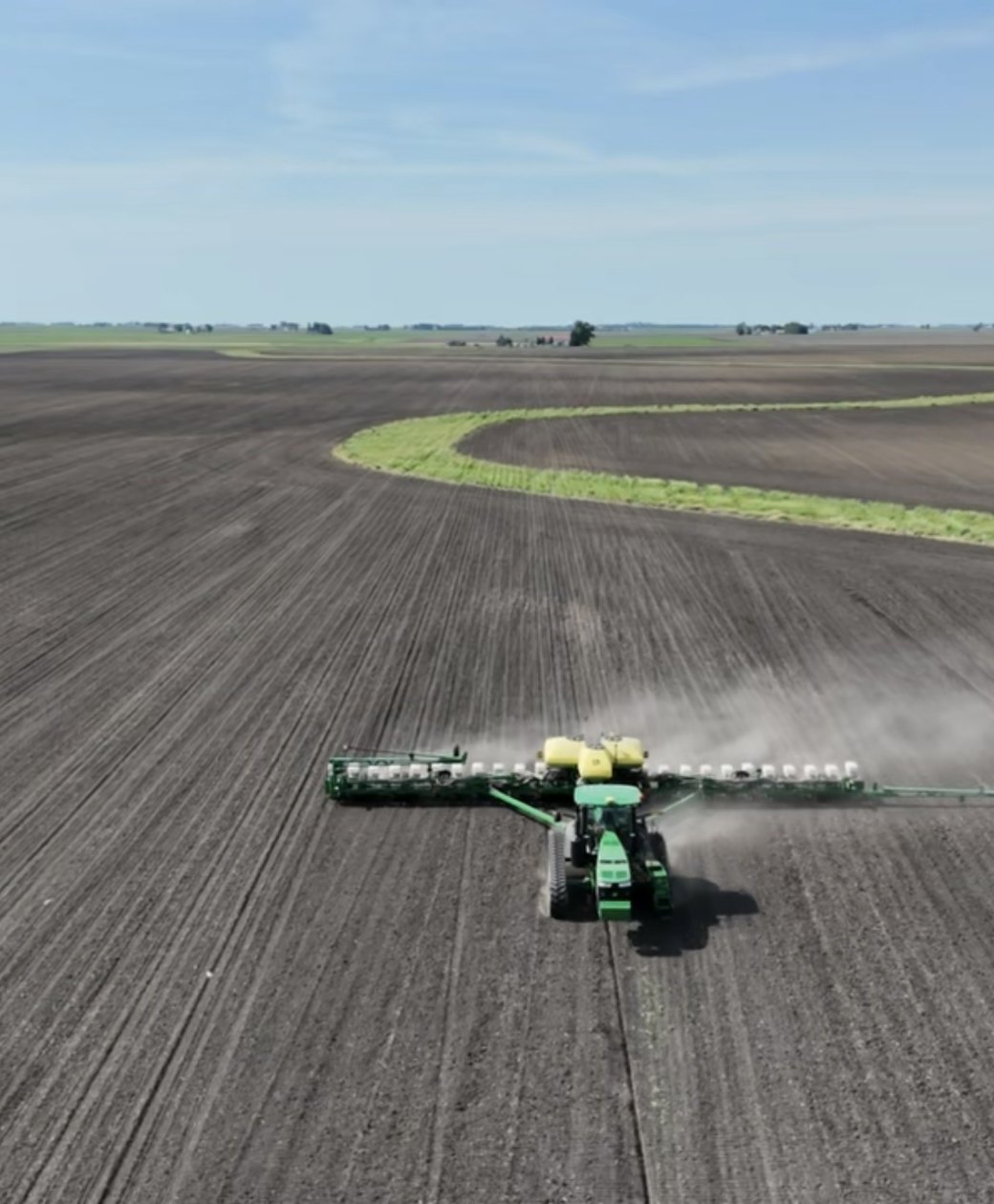
In-Season Corn Decisions: The Calls That Make or Break the Crop
Corn makes its yield in a handful of narrow windows between emergence and grain fill — and most of those decisions get made in the truck, between everything else. Here's the in-season decision sequence that actually moves yield, and how an AI advisor grounded in your fields helps you catch each window on time.

The season doesn't wait for you
Here's the thing about growing corn that nobody tells you when you're starting out: the crop makes most of its yield in a handful of narrow windows, and almost none of those windows line up with when you have time to think about them. Stand establishment, early pest pressure, nitrogen timing, the weed-control window, the disease call around tassel — each one is a decision that pays or costs you real bushels, and each one tends to come due right when the planter's down, or it's raining, or the loan paperwork is on the kitchen table.
The agronomy itself, for most of these, is well understood. We know what a good stand looks like. We know roughly when to sidedress and what a denitrifying rain does to your nitrogen. We know the growth stages where a fungicide pencils and the ones where it doesn't. The hard part was never the textbook. The hard part is catching the window — noticing that this particular field, this particular week, needs a decision, while you're standing in a different field doing something else.
That's the gap I want to walk through here. I'll go decision by decision through the in-season corn calendar, lay out how I'd think about each call, and show you where an AI advisor that actually knows your fields earns its place — not by making the decision for you, but by making sure the decision gets to you before the window closes.
Decision 1: Stand and replant (emergence through V2)
The first real call of the season comes a week or two after the corn cracks the ground: did you get the stand you paid for, and is it uniform?
This is two questions, and the second one matters more than people think. A field that averages a good population but came up ragged — skips, doubles, a three-leaf plant next to one that's barely spiking — gives up yield to uneven competition even when the stand count looks fine on paper. So you're really assessing both the number and the evenness.
When the stand is genuinely thin or badly gapped, you're into replant math, and it's a colder calculation than most of us want it to be in the moment. Replanting costs you seed, fuel, time, and a later planting date — and a later planting date carries its own yield penalty. The honest question isn't "does it bother me to look at," it's "does the expected yield of the replanted stand, minus the cost and the calendar penalty, beat what the existing thin stand will give me?" Sometimes it does. Often it doesn't, and the right move is to leave a stand that looks worse than you'd like.
Where Clevis helps: it watches NDVI imagery on your fields and flags emergence that's coming in uneven against your own planting records, so a problem field gets your attention early instead of on your next drive-by. You can photograph a trouble spot and get help identifying whether you're looking at a pest, a crusting issue, or a seed-depth problem. And because the platform knows that field's costs and history, the replant question gets framed the way it should be — as a profit-per-acre decision on that ground, not a gut reaction.
Decision 2: Early-season pest pressure
Right alongside stand assessment comes the first scouting season — black cutworm, armyworm, and the early defoliators that can take a stand apart faster than you'd believe if they catch you not looking.
I'll be straight about this one because it's where the "AI will scout for you" pitch gets oversold: nothing replaces boots in the field early in the season. The AI doesn't walk your ground. What it does do is sharpen the scouting you're already doing. Snap a photo of feeding damage or an insect in the field and it'll help you identify what you're dealing with and whether the pressure and growth stage warrant treatment. Catch cutworm damage early enough and an insecticide can save a portion of a field that would otherwise be a replant decision two weeks later — the difference between a cheap rescue and an expensive one is almost always how fast you caught it.
So treat the AI as a second set of eyes on what you found, not a substitute for going and finding it. The farmers who get the most out of it are the ones still scouting; it just makes their scouting faster and their ID more certain.
Decision 3: Nitrogen timing
If there's one in-season decision where knowing your specific fields beats knowing the average, it's nitrogen.
Corn's nitrogen demand ramps hard from roughly V6 through tasseling, and the risk isn't just how much N you applied — it's how much of it is still there when the crop wants it. A heavy rain on the wrong soil at the wrong time moves nitrogen through leaching or denitrifies it out of reach, and two fields that got the same pre-plant program can be in very different shape after the same storm depending on soil type and drainage.
This is exactly the kind of thing that's hard to track in your head across a whole operation and easy to track with the right data. Clevis follows accumulated growing degree days and cumulative rainfall on each field, so it knows where your corn is in its development and how much water has moved through each field's profile. After a big rain event, that's the basis for flagging which fields are most at risk of an N shortfall and may warrant a sidedress or rescue application — and, just as importantly, which ones don't, so you're not spending money on a pass a field didn't need.
The decision is still yours; your nitrogen plan and your risk tolerance are yours. But making it with each field's real GDD and rainfall in front of you beats making it off a windshield impression of "it rained a lot this year."
Decision 4: The post-emergence weed window
Weed control is a deadline disguised as a task. Post-emergence herbicides work on a weed-size window — small weeds, labeled height — and that window is short and unforgiving. Miss it, and you're choosing between a less effective application, a more expensive one, and the yield you already gave up to early-season weed competition, which is larger than most people credit.
The trouble is the window is defined by growth — both the weeds' and the crop's — not by the calendar, so "I'll get to it this weekend" is how good herbicide programs turn into mediocre ones. Tracking crop stage by growing degree days, field by field, is the kind of quiet bookkeeping that keeps the window from sneaking past you while you're focused on something else. Bringing the timing to you, on the field that needs it, is half the battle.
Decision 5: Disease and the fungicide call (VT–R1)
The tassel-to-silk window brings the decision farmers ask me about most: do I spray a fungicide, and is it worth it?
The honest answer is the same one I give on marketing — it depends, and anyone who tells you to spray every acre every year is selling something. Diseases like tar spot and gray leaf spot thrive under specific conditions: susceptible hybrid, the right humidity and canopy moisture, disease already present in the area. When those line up at VT–R1, a fungicide can protect real yield. When they don't, you're spending money to ease your mind, and on a thin-margin year that's money that belonged somewhere else.
So this is a profitability decision wearing an agronomy hat. The inputs to it are your hybrid's disease package, what the canopy and weather have been doing, NDVI trends that can hint at stress, and what the disease pressure looks like in your area — weighed against the cost of the pass and a realistic yield response. An AI advisor that's tracking your fields' conditions and can hold the cost side of the math at the same time turns "everybody's spraying so I guess I should" into an actual decision on each field.
The thread through all of it: proactive, not just reactive
Notice the pattern across those five decisions. In every one, the agronomy is the easy part. The hard part is attention — knowing which field needs a decision this week while you're busy with the rest of the operation.
That's the piece I'm proudest of in what we've built. Clevis isn't only there to answer when you ask. Because it's continuously tracking accumulated GDD, cumulative rainfall, and field-level NDVI across your operation, it runs inference on that data to surface insights before you go looking — here's the field to walk today, here's the one most exposed after that rain, here's where emergence came in uneven. Proactive when it can be, reactive when you need it to be. That's our proprietary algorithmic inference doing the watching so the decisions come to you instead of waiting for you to have a free afternoon to go find them.
And I'll say plainly what I've said elsewhere: the agronomic features we have releasing this season are the ones I'm most excited about on the whole roadmap. What I've described here is live and working today. What's coming next is going to raise the bar on what a farmer should expect an in-season agronomic tool to do, and I'd rather show it to you when it ships than oversell it now. It's close.
What this is not
In the same spirit of real talk: this does not replace walking your fields, and it does not replace your agronomist. The best operators I know will still put boots on the ground and still lean on a trusted agronomist — most of whom, by the way, are using AI tools themselves now. What an AI advisor adds is coverage and timing: a second brain that watches every field at once, keeps the profitability question at the center, and makes sure the call gets to you while you can still make it well.
Who this is for
The mid-size corn grower who is his own agronomy department — making every one of these calls himself, in the truck, between fields, while the season refuses to slow down. If you've got a full-time agronomist-manager walking your ground every day, you already have a version of this. If that person is you, having each field's GDD, rainfall, and NDVI stay current on their own — and having the decisions surface before the window closes — is the difference between farming the crop and chasing it.
If you grow corn in the Midwest and you want a second set of eyes on every field this season, the morning brief is a fine place to start. It's free, it's farmer-up, and it'll have the field news on your kitchen table before you've finished your coffee.
Keep reading
- Agronomy · 9 min read
In-Season Soybean Decisions: The Calls That Quietly Decide Your Bean Yield
Soybeans forgive more than corn — which is exactly why their in-season decisions get overlooked until they've already cost you. Here's the bean decision sequence that actually moves yield, and how an AI advisor grounded in your fields helps you catch each window before it closes.
Read - Agronomy · 5 min read
Will AI Replace Your Crop Consultant? An Honest Take
Short answer: no — and here's the part most people miss. Your agronomist is probably already using AI. So the real question isn't human vs. machine; it's what an AI grounded in your whole operation adds to the expertise you already trust.
Read - Skeptics · 8 min read
AI for Grain Farmers: An Honest Field Report
I've watched software get sold to farmers for twenty years, so here's the straight scorecard on AI for grain farmers — where it earns its keep, where it still falls short, and what changes in the next month or two.
Read - Founder · 11 min read
Why I Built an AI Farm Advisor After 20 Years in the Midwest Ag Industry
I'm a Midwest crop scientist turned independent consultant who spent 20+ years inside the ag industry before founding Clevis AI. Here's the day in central Illinois that made me certain farmers needed an AI advisor built farmer-up, not corporate-down.
Read