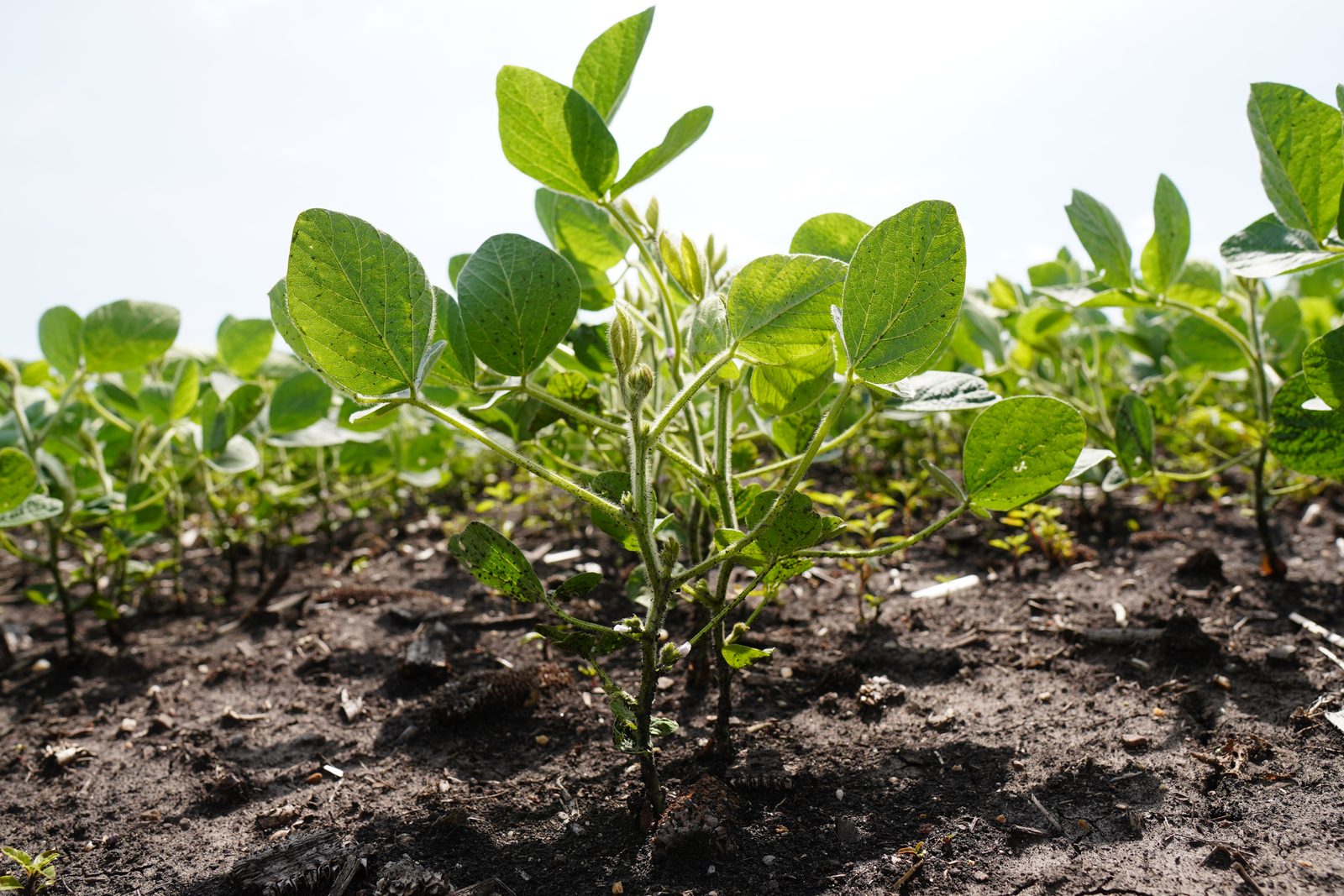
In-Season Soybean Decisions: The Calls That Quietly Decide Your Bean Yield
Soybeans forgive more than corn — which is exactly why their in-season decisions get overlooked until they've already cost you. Here's the bean decision sequence that actually moves yield, and how an AI advisor grounded in your fields helps you catch each window before it closes.

The bean crop forgives — until it doesn't
Soybeans have a reputation for taking care of themselves, and there's truth in it. The bean is a remarkably forgiving plant: it branches to fill gaps in a thin stand, it flowers over a long stretch instead of betting everything on one window, and it'll set pods to match the season it's handed. After the white-knuckle precision of getting corn planted and fed, a lot of us treat soybeans as the crop we can relax about.
That reputation is exactly what costs people bushels. Because the bean compensates so well, its in-season decisions don't announce themselves the way corn's do — there's no dramatic nitrogen-loss rain, no tassel-stage deadline staring you down. The windows are quieter. And quiet windows are the easiest ones to let slide while you're busy with everything else, right up until you're standing in a white-mold pocket at R5 or a waterhemp escape that went to seed, realizing the decision got made for you by default.
So I want to walk the in-season soybean calendar the way I walk the corn one — decision by decision, how I'd think about each call, and where an AI advisor that actually knows your fields earns its place. Not by making the decision for you, but by making sure each quiet window gets to you before it closes.
Decision 1: Stand and replant (emergence through V2)
The first call comes a week or two after emergence, and here's where soybeans genuinely are different from corn: the replant bar is much higher, and most of the time the right answer is to leave it.
A soybean plant compensates for its missing neighbors in ways corn simply can't. It branches out, sets more pods per plant, and a final stand well below what you planted can still pull a near-full yield if it's reasonably distributed. Evenness matters less than it does in corn, too — the bean's long flowering window papers over a lot of early raggedness. So when you're looking at a stand that disappoints you, the honest math usually favors patience. Replanting costs seed, fuel, time, and a later planting date that carries its own penalty, and you're often replacing a stand that would have yielded most of the way there on its own.
That doesn't mean never. Genuine failures happen — a crusted-over field, a drowned-out low spot, a seedling-disease wipeout — and those get a cold replant calculation just like corn: does the expected yield of the replant, minus the cost and the calendar penalty, beat what the existing stand will give me? The difference with beans is that the bar sits higher, and a lot of stands that look like they need help don't. Knowing the difference is the whole decision.
Decision 2: Early pressure — seedling disease and the first defoliators
The early-season threats to beans are mostly decided before you ever scout them, and that's worth being honest about.
Seedling diseases — Pythium, Phytophthora, Rhizoctonia — show up when you plant into cold, wet ground and the bean sits there vulnerable. By the time you see the gaps, the call that mattered was the one you already made: variety resistance, seed treatment, and whether you planted ahead of a cold rain. That's not nothing to know going forward, but it reframes the in-season job from "rescue" to "assess and learn." Where early stand loss is real and ongoing, you're back in the replant math from Decision 1.
Then there are the early defoliators — bean leaf beetle being the classic — chewing on cotyledons and first trifoliates. Young beans tolerate a surprising amount of leaf loss, so the decision here is mostly about not overreacting: a field can look chewed-up and still be nowhere near a threshold that justifies a pass. The real skill early is telling cosmetic damage apart from the rare case that's actually compounding into stand loss. Most years, the right move is to note it, keep watching, and save the spray.
Decision 3: The weed window and the trait-system trap
If there's one in-season soybean decision that has gotten genuinely harder in the last decade, it's weeds — and it's because the weeds changed. Waterhemp and Palmer amaranth have stacked up resistance to multiple herbicide groups, they germinate in flushes all season, and a Palmer plant can put out hundreds of thousands of seeds. This is the decision that punishes a missed window the hardest, because the cost isn't just this year's yield — it's the seed bank you hand next year's crop.
Two things make or break it. The first is that a strong pre-emergence residual is the real hero of the program; leaning entirely on post-emergence rescue is how resistance got built in the first place. The second is that the post window is defined by weed size, not the calendar — small weeds, at the labeled height, are the only ones you can count on controlling. "I'll get to it this weekend" is how a four-inch waterhemp becomes a ten-inch one that shrugs off the pass.
Layered on top of all that is the trait-system complexity that didn't exist a generation ago: which platform your beans are — dicamba-tolerant, Enlist, conventional — dictates what you can legally and effectively spray, and the dicamba systems in particular carry application cutoff dates and temperature-inversion restrictions you have to respect. That's a lot of moving constraints to hold in your head per field, on a window that's measured in days. Tracking crop and weed stage field by field, and keeping the cutoffs and conditions in front of you, is exactly the quiet bookkeeping that keeps this window from slipping.
Decision 4: White mold and the R1 fungicide call
The marquee soybean disease decision in the upper Midwest is white mold, and it has a twist that catches people: it's a preventive call. By the time you see the bleached stems and the white fluff at R5, the decision is behind you. The fungicide application that protects yield goes on around R1 — beginning bloom — before symptoms show, because it's the flowers the fungus colonizes first.
That makes it a conditions-and-history bet, and the conditions are specific: white mold likes a cool, wet, humid stretch under a dense canopy that's already closing the rows, on a field with a history of it. When those line up at flowering, a well-timed application protects real bushels. When they don't — hot, dry, open canopy, no history — you're spending money to ease your mind, and on a thin-margin year that money belonged somewhere else. Anyone who tells you to spray every bean acre every year is selling something.
And here's the honest companion to that: not every soybean disease has a rescue. Sudden death syndrome and frogeye leaf spot are managed mostly up front — variety selection, seed treatment, rotation — not by a midseason pass you can reach for once you see symptoms. Part of making the white-mold call well is knowing which diseases you can still do something about in-season and which ones already had their decision made at the seed bag. The fungicide question, like the marketing question, is a profitability decision wearing an agronomy hat: your variety's disease package, what the canopy and weather have been doing, the field's history, weighed against the cost of the pass and a realistic yield response.
Decision 5: Pod fill and the late-season pests (R3 through R6)
Here's the thing about soybeans that's easy to forget when the crop looks made: the yield is actually set late. Pods fill from R3 through R6, and the plant is still deciding how many pods to keep and how heavy to fill them deep into that stretch. Stress that lands during pod fill — drought, defoliation, a pest flare — costs you directly, which is why the late-season scouting decisions matter more in beans than the relaxed reputation suggests.
The defoliation thresholds tighten once the plant is flowering and filling: a bean can shrug off heavy leaf loss before bloom, but the same percentage during pod fill is a different conversation, and that's the window when Japanese beetles, grasshoppers, and the like are working. Soybean aphid is the classic one to actually count rather than eyeball — the long-standing economic threshold is around 250 aphids per plant with populations increasing, through about R5, and getting that count right keeps you from spraying a population that was about to crash on its own. In a dry year, watch the field edges for spider mites, which flare in drought and move inward. Into R5 and R6, pod feeders like stink bugs become the concern, because now they're damaging the seed you've already set. And in parts of the Midwest, soybean gall midge has shown up as a newer threat worth knowing whether you're in its range.
None of these wants a spray by default. The decision in every case is the same shape: is the pressure actually past threshold on this field, this week, with enough season left for the damage to matter — weighed against the cost of the pass. Protecting the pods you've worked all season to set is worth the attention; spraying a sub-threshold population is just cost.
The thread through all of it: attention, not just agronomy
Notice the pattern, the same one that runs through the corn calendar. In nearly every one of these decisions, the agronomy is the knowable part. The hard part is attention — knowing which field has quietly walked into a decision this week while you're busy with the rest of the operation. And beans make that harder than corn precisely because their windows don't shout.
That's the piece I'm proudest of in what we've built. Clevis isn't only there to answer when you ask. Because it's continuously tracking accumulated growing degree days, cumulative rainfall, and field-level NDVI across your operation, it runs inference on that data to surface insights before you go looking — this field's canopy closed early and just caught a cool, wet stretch, so it's your white-mold risk to watch; this one's the replant question; this edge is drying down faster than the rest. Proactive when it can be, reactive when you need it to be. That's our proprietary algorithmic inference doing the watching, so the quiet windows come to you instead of waiting for a free afternoon you don't have.
I'll say plainly what I've said elsewhere: the agronomic features releasing this season are the ones I'm most excited about on the whole roadmap. What I've described here is live and working today. What's coming next is going to raise the bar on what a farmer should expect an in-season agronomic tool to do — and I'd rather show it to you when it ships than oversell it now. It's close.
What this is not
In the same spirit of real talk: this does not replace walking your fields, and it does not replace your agronomist. The best operators I know will still put boots in the beans — pulling back the canopy to check for white mold, counting aphids, measuring weeds against the label — and still lean on a trusted agronomist, most of whom are using AI tools themselves now. What an AI advisor adds is coverage and timing: a second brain that watches every field at once, keeps the profitability question at the center, and makes sure the call gets to you while you can still make it well.
Who this is for
The mid-size grower who is his own agronomy department — making every one of these calls himself, in the truck, between fields, while the season refuses to slow down. If you've got a full-time agronomist-manager walking your ground every day, you already have a version of this. If that person is you, having each field's growing degree days, rainfall, and canopy condition stay current on their own — and having the quiet decisions surface before the window closes — is the difference between farming the crop and chasing it.
If you grow soybeans and corn in the Midwest and you want a second set of eyes on every field this season, the morning brief is a fine place to start. It's free, it's farmer-up, and it'll have the field news on your kitchen table before you've finished your coffee.
Keep reading
- Agronomy · 5 min read
Will AI Replace Your Crop Consultant? An Honest Take
Short answer: no — and here's the part most people miss. Your agronomist is probably already using AI. So the real question isn't human vs. machine; it's what an AI grounded in your whole operation adds to the expertise you already trust.
Read - Agronomy · 8 min read
In-Season Corn Decisions: The Calls That Make or Break the Crop
Corn makes its yield in a handful of narrow windows between emergence and grain fill — and most of those decisions get made in the truck, between everything else. Here's the in-season decision sequence that actually moves yield, and how an AI advisor grounded in your fields helps you catch each window on time.
Read - Skeptics · 8 min read
AI for Grain Farmers: An Honest Field Report
I've watched software get sold to farmers for twenty years, so here's the straight scorecard on AI for grain farmers — where it earns its keep, where it still falls short, and what changes in the next month or two.
Read - Founder · 11 min read
Why I Built an AI Farm Advisor After 20 Years in the Midwest Ag Industry
I'm a Midwest crop scientist turned independent consultant who spent 20+ years inside the ag industry before founding Clevis AI. Here's the day in central Illinois that made me certain farmers needed an AI advisor built farmer-up, not corporate-down.
Read